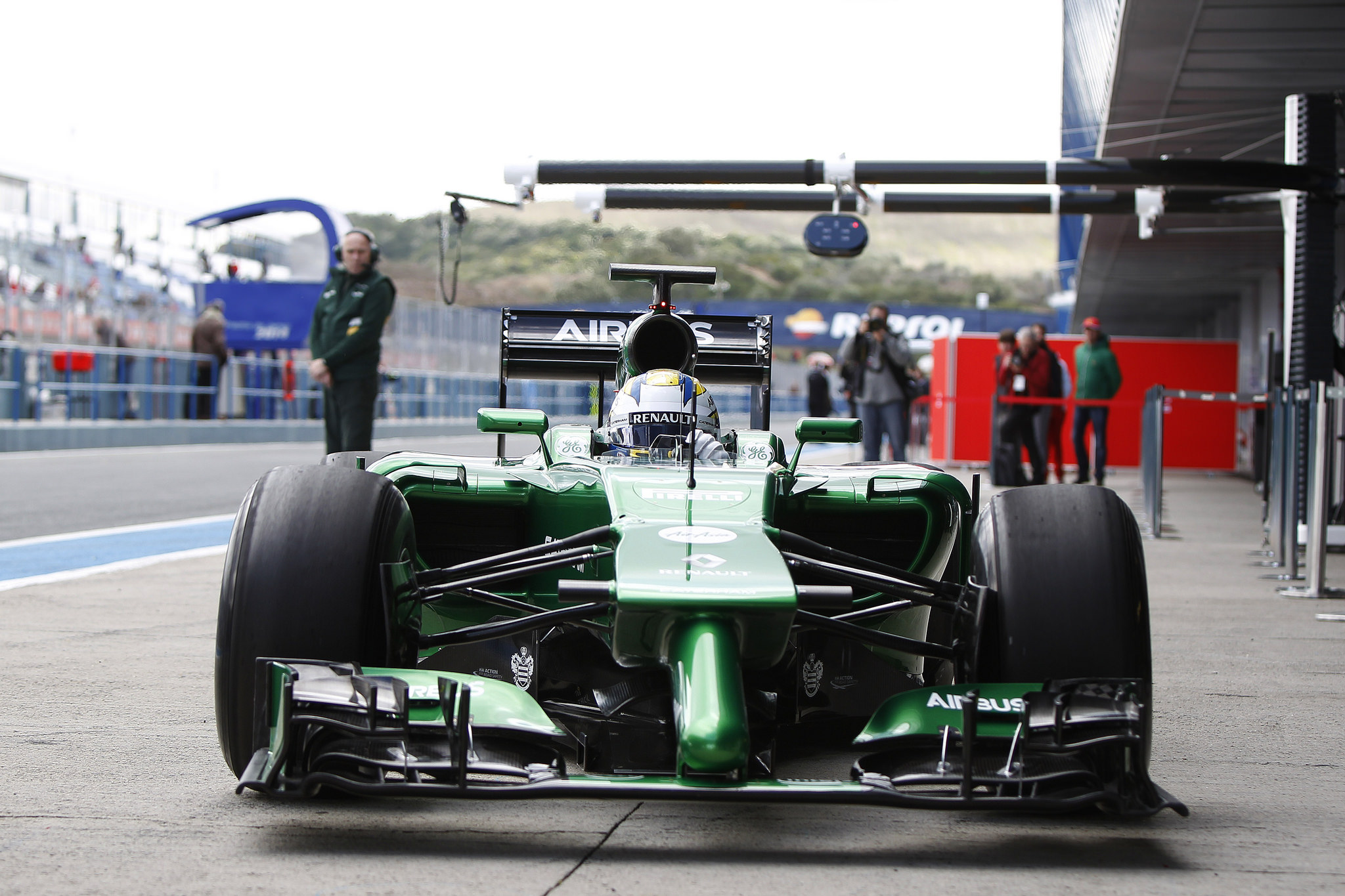
Nosey Caterham stirs up debate

12206525034_9ea9e21fd0_k

12206526384_fe396ef29d_k

12206119835_b5651e2f11_k

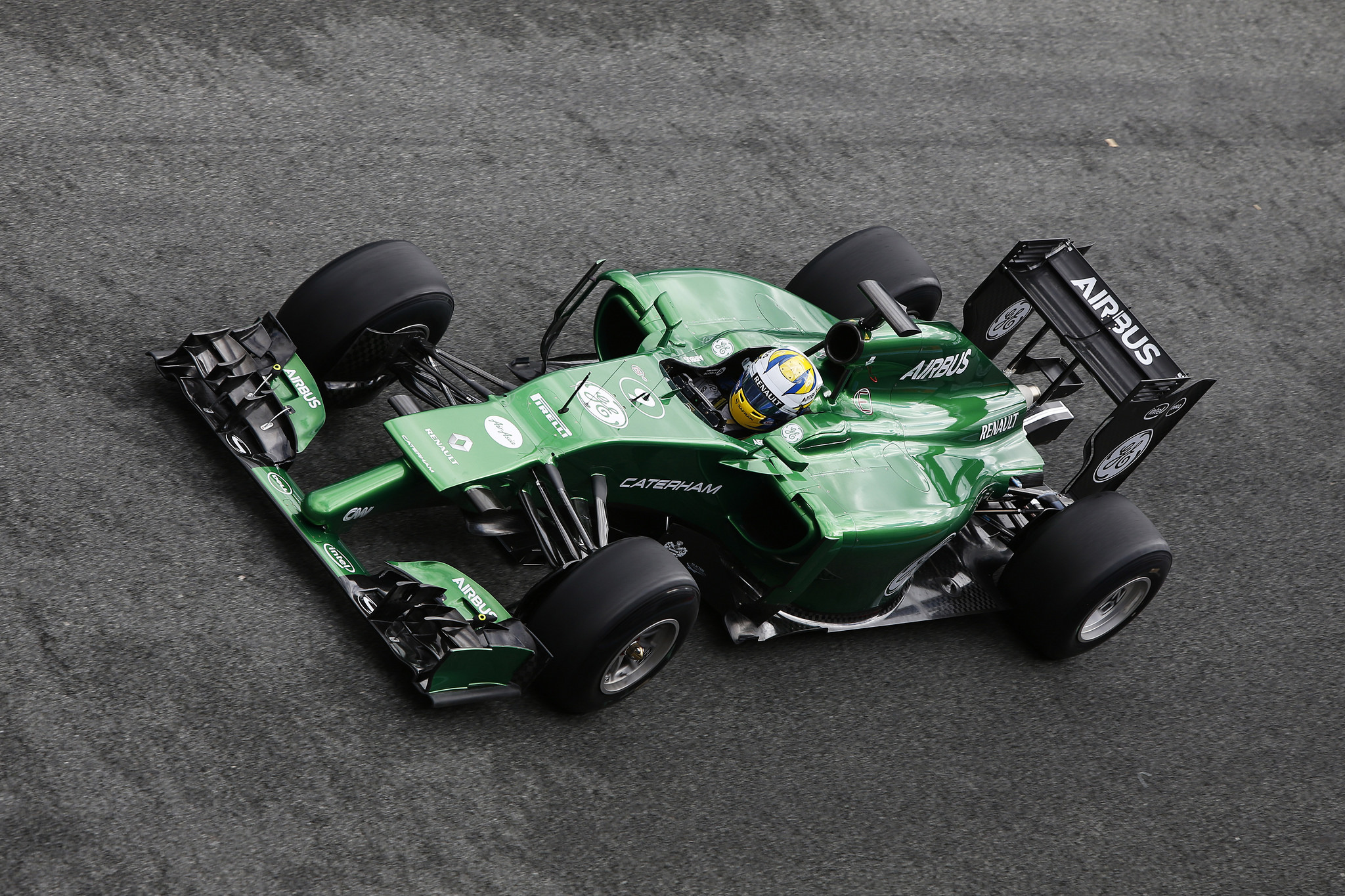
CT05 – the Caterham F1 car that Kamui Kobayashi and Marcus Ericsson will be competing with – has been unveiled in Jerez, Spain.

The first to be fully designed and built at Caterham’s Leafield Technical Centre, CT05 will race in the team’s new all-green 2014 livery and, for the fourth year in a row, will be powered by Renault Sport F1, using the new Renault Energy F1 engine mated to a Red Bull Technology gearbox.

Says Cyril Abiteboul, Caterham’s Team Principal and CEO:

“The 2014 car is now much closer to many of the teams ahead and, this year, there is no reason for this to not materialise directly to performance on track.

“We believe CT05 is a good starting point for us to deal with the new regulations and their associated challenges, in particular in terms of reliability. We obviously won’t know where we really are in relation to the other teams until the first race, but we believe we have answered the challenges presented by the new regulations as effectively as we can.

“We also have a very good reason to be positive about how this car will develop throughout the season ahead. Thanks to our relocation in 2012 to at the core of the ‘F1 valley’, and a highly selective recruitment plan, our staff are now a good mix of experience and young talent and we have moved our wind-tunnel programme to the Toyota Motorsport GmbH (TMG) facility in Cologne, Germany.

“This means we are now working at 60% scale, a significant improvement over our previous facility and another sign of just how serious we are about making real progress this year.

“In addition to the TMG move is an improved partnership with Dell/Intel which gives us, among many other benefits, a major upgrade to our CFD capability, a critical part of our design toolbox that is even more important this year with the rule changes governing wind-tunnel use in 2014.

“In Renault Sport F1 and Red Bull Technology we have technical partners that have powered the World Championship winning team for the last four years, and, while we are realistic enough to know we are very unlikely to be competing right at the front of the grid, there is no reason why we should not be fighting higher than we have done since we came into the sport in 2010.

“We have extensive experience of working with both Renault and Red Bull and that is going to be crucial this year. Reliability and energy management will play a key role in 2014, especially early in the season, so our experience of working so closely with both organisations since 2011 will definitely help throughout the course of the season.”

Despite the major rule changes introduced this season, the team’s design philosophy was actually only slightly different to usual for a totally new car. Says Mark Smith, Technical Director:

“We have still sought to maximise aero and mechanical performance within the regulations but there has been more emphasis than usual placed upon weight reduction and, bearing in mind how critical reliability will be this year, we have been slightly more conservative in the areas around the new power unit – cooling systems, exhausts, heat management, and so on.

“At the front of the car, the area that will obviously inspire most debate, we have focused a lot of effort on optimising flow structures around the nose, the front of the chassis and the reduced width front wing area, all in response to the 2014 regulation changes.

“However, the package we start testing with is by no means our definitive answer and we fully expect to evaluate alternative solutions throughout the course of 2014, particularly now our 60% scale work has started in the TMG wind tunnel in Cologne and our improved Dell/Intel HPC (High Performance Cluster) is coming on stream, significantly stepping up our CFD resource.”

Overall there were a number of other major areas the design team focused on – the front chassis height led them to opt for pullrod suspension which, according to the team, provides the best solution from both a mechanical and aerodynamic perspective.

Another focus area was cooling – charge air cooler packaging has driven the cooling architecture and consequently the sidepod and rear-deck bodywork and, at the rear end of the car, development has been driven by the removal of the beam wing, again as per 2014 regulations, and the exhaust ‘blowing’ effect we’ve seen in recent years – this has created a challenge all teams will face, how to recover the rear load generated by those areas in previous seasons, and, again, something that will continue to develop throughout the season ahead.

For all those trying to lose weight

photo


‘Nuff said… Had me laughing anyway.

The new Williams

WF1_FW36_ISO-gallerywide

WF1_FW36_SIDE-gallerywide


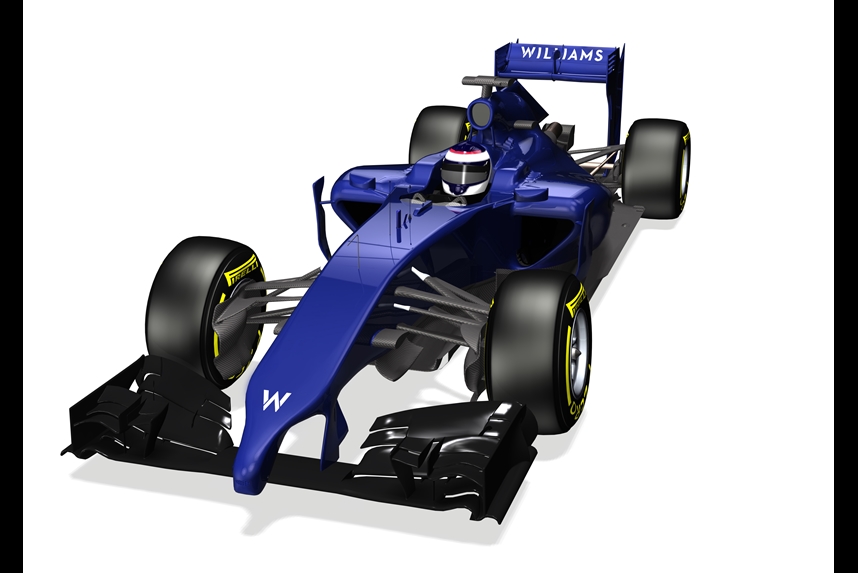
Williams has released the first images of its 2014 challenger: the Williams Mercedes FW36.

It’s the culmination of two-plus years research and development by the team’s technical departments in Grove and it incorporates the power unit from the team’s new partner, Mercedes-Benz.

Says Chief Technical Officer, Pat Symonds:

“There’s a lot more technology on the cars this year. We’ve had turbo-charged engines in F1 before; what’s different this time is that it is much more than just an engine change, it is a completely different system.

“We’ve gone from a slightly hybridised, normally aspirated engine to a fully integrated hybrid power unit with novel technology at its heart.”

To meet the challenges of the new power unit, Williams signed the deal with Mercedes-Benz High Performance Powertrains midway through last season. The team received the first CAD (computer-aided design) data for the power unit at the end of May, at which point the detailed design of the FW36 could begin to be finalised.

This is the first time that Williams has worked with Mercedes in F1.

The design phase of the FW36 was completed by mid-September, by which time the team had found solutions to the major challenges presented by the regulations. (Cooling, weight, a new gearbox and aerodynamic changes are just some of the areas of focus.)

Continues Symonds:

“Overall the cars will need more cooling this year. The demands on water and oil cooling may be slightly diminished, but the ERS system is significantly more powerful and hence needs more cooling. We also have to cool the charge air from the turbocharger compressor which requires a substantial intercooler.”

The FW36’s gearbox ran on the dyno for the first time at the beginning of November, before running with the full power unit several weeks later. It’s the first eight-speed gearbox in Williams’ history.

Says Symonds:

“We finished the gearbox relatively early. It’s completed a lot of running on the test rig and at Mercedes HPP in Brixworth, but you can’t take reliability for granted. It’s a completely new box and it has to cope with a lot more torque than was the case with the V8.”

The weight of the car, when combined with the FIA’s ever more stringent crash tests, has been another challenge of the 2014 rules. But the FW36 was one of the first cars to pass its crash tests prior to Christmas.

“The build of the new car has gone remarkably smoothly,” says Symonds. “But it’s been a challenge to get the car down to the weight limit. It’s been achievable, but it hasn’t been easy because the new power unit is heavier than the outgoing V8.”

The launch-spec aerodynamic package was finalised in the first week of December, with an upgrade package for Melbourne’s season-opener signed off in early January.

Adds Symonds:

“F1 is still going to be an aerodynamic formula in 2014. There are some significant changes: the nose is lower than last year and the front wing is narrower, which means the end plates are now more shrouded by the front tyre.

“The rear wing isn’t as deep as last year and the beam wing below it is no longer permitted, and we’ve also lost the ability to use the exhaust to enhance aero performance.”

Until the car begins testing the team won’t know how its design solutions will translate on to the track, but Symonds is confident that Williams has done enough to move up the grid after a disappointing 2013 season.

“I’m confident that we’ll be closer to the front aerodynamically than we were last year,” he says. “Our ambition for the year ahead is to have a strong 2014 season.”

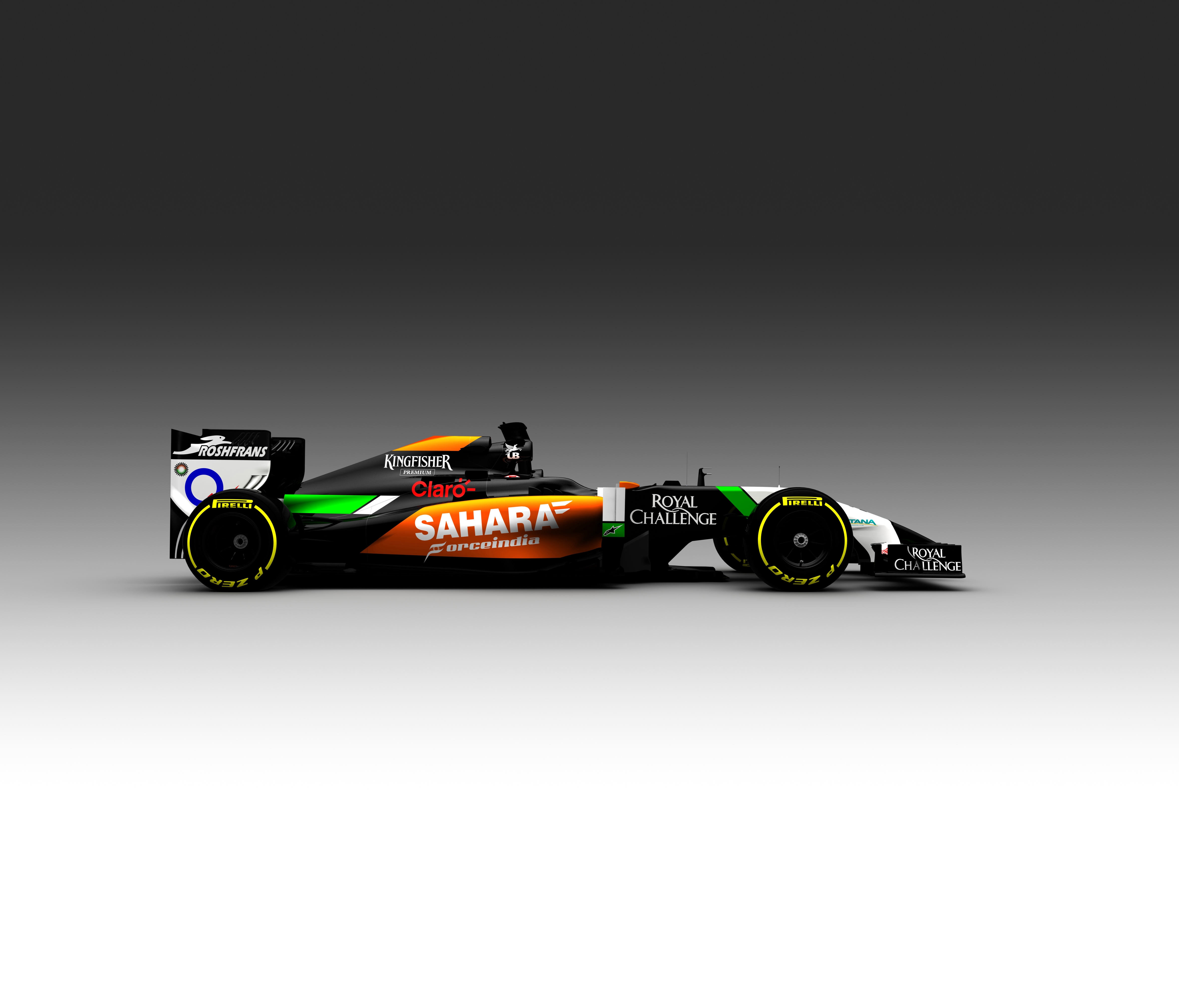
Force India first to launch 2014 car

The only view we've been given of the Force India's new VJM07

The only view we’ve been given of Force India’s new VJM07


The coming Formula One season should be a momentous one in which the biggest regulation changes in a decade will offer an opportunity to shake up the competitive order.

As it enters its seventh season in the sport, Sahara Force India Formula One becomes the first of the teams to reveal its contender for the 2014 season, with drivers Nico Hulkenberg and, fresh from McLaren, Sergio Perez. Technical director, Andy Green talks about the car’s new look, aerodynamic changes and other areas of development:

How would you sum up the overall look of the VJM07?

“Apart from the obvious, it doesn’t look hugely different, but it is; almost every single part is a new design, from the front wing right back to the diffuser.

“Its genetics still lie in the 2013 car, but we’ve had to achieve the same results in a slightly different way. The nose is a stand-out but from the nose backwards it looks quite similar. It’s a little bit ‘fatter’ for the increased cooling requirements, but we hope to trim that out during the early part of the season.

“To be competitive we have to develop and because there are so many areas that need significantly refining, optimising the performance of this car is going to be a big challenge.”

How key are the aerodynamic changes for this year?

“The aerodynamic changes in themselves would have been significant, even if there had been no other regulation changes. There’s quite a dramatic reduction in downforce, especially with regard to the exhaust – there’s now very little you can do to capture the exhaust energy.

“That’s a big loss on the exit of corners, so traction becomes a premium. That, combined with a change in the front wing width, has changed all the flow structures on the car completely.”

Is the narrower front wing the biggest change?

“The front wing change is significant; it’s a completely different concept for 2014. Visually it’s one of the biggest changes. That was a big task, rebuilding all those aerodynamic structures from the front to the back to complement the smaller rear wing.

“The loss of the lower rear wing, or beam wing, leads to a significant loss of performance. That lower wing helped connect the diffuser to the top wing and gave those two areas a lot of support. Without it, it’s become very difficult to extract performance and it’s going to be quite a tricky area to keep stable. So there was quite a dramatic loss in headline downforce numbers, while there was also a drop in drag, which has fallen quite dramatically as well.”

Will noses be a key area of development?

“Our nose is a launch spec and later we will have an updated front end of the car, which potentially is quite different. We had to take quite a pragmatic view of it and say we’ve got to go testing so we’ve got to get a car out of the door.

“As much as we want to push the boundaries of the impact structure, because we know how important they are for the whole car, we don’t have the resources to push it to the limit in our first iteration, so we need a banker. The nose that is on the launch car is a banker.

“We’ve got ourselves a car that we can go testing and racing with. Several weeks ago we started pushing the design boundaries because we think there’s performance in it. There are new concepts coming through.”

Everyone has to choose eight ratios for the season. Have you simply followed the selection made by Mercedes?

“Although our ratios are supplied by Mercedes we also did our own simulations, and to be honest we came up with very similar answers. We were happy to carry on that route. We are allowed one change and I think we’ll wait and see how it performs and how it compares to our simulation.

“The good news is that lengthy ratio discussions (which gears to lengthen or shorten) will become a thing of the past, so that saves a small amount of work track side! The ratios look fairly benign, from what we can see from our preliminary solutions.”

How hard has it been to fit the new power unit into the overall package?

“It’s been a massive job to accommodate all the changes to the power unit – it’s the biggest change I’ve witnessed in the sport since I started in 1990.

“On top of that, if you add the development that comes with it during the season, it’s going to take some managing. From the first time the car runs it will be continual development as we gather data, understand where the car sits relative to our models, refine it, and go back to the track again.”

What’s been the biggest challenge in terms of packaging?

“Cooling has been the biggest challenge – most of last summer was taken up trying to understand the cooling requirements of the power unit, and how best to optimise it in the chassis. There’s a lot more to cool and you are weighing up the performance of the power unit versus the performance of the chassis and aerodynamics, and trying to hit the optimum on each one of them.

“We’ve had to develop a completely new tool set to examine, analyse and optimise it. We won’t get a real answer on how far out we were until we start running and then we’ll refine the tools again and have another go at it. I expect quite a big redefinition of the cooling system later in the season once we’ve gathered all the data from the winter testing and the first couple of races.”

What else is new this year?

“The braking system is a significant change; the rear system is effectively a brake by wire. This means the rear brakes can now respond completely differently from the way they have traditionally done before.

“A lot of work has gone into this system from simulation, design to testing it on the dyno. However, we won’t fully know how the system will perform until we get on track and gather some data and driver feedback.”

Summary of new F1 regs for 2014

The 2014 season will feature the biggest change in regulations in a decade, providing an extra challenge and opportunity for the teams.

With new engines seeing the light and new aerodynamic restrictions, the 2014 cars will look very different from their predecessors – outside and inside their bodywork.

The new rules in a nutshell:

New 1.6-litre, V6 power units with a single turbocharger are introduced. Kinetic energy from braking and heat from the exhausts are harvested, putting a greater emphasis on energy recovery.

• The minimum car weight increases from 642 kg to 690 kg to accommodate the new technologies.

Exhausts are now exiting from the rear of the car, preventing exhaust gases from having an aerodynamic influence.

Front wings are 100 mm narrower; rear wings are smaller, with the lower or beam rear wing now outlawed.

Nose profiles are now lower to ensure they meet with anti-side intrusion panels during potential T-boning accidents and improve the nose to wheel anti-launch capability.

• The power units are deemed to comprise six separate elements – engine (ICE), motor generator unit – kinetic (MGU-K), motor generator unit – heat (MGU-H), energy store (ES), turbocharger (TC) and control electronics (CE).

• Drivers will be allowed to use five power units throughout the season. Usage of additional ones will incur penalties, with the replacement of a complete unit warranting a pit lane start.

• Drivers will be required to use the same gearbox for six consecutive events (Saturday and Sunday sessions only). Replacements will cause a grid penalty.

Fuel limits for the race have been set to 100 kg.

• The final race of the season, the Abu Dhabi Grand Prix, will award double points in both the Drivers’ and Constructors’ Championships.

• A new trophy will be awarded to the driver recording the most pole positions in the season.

• Drivers will now carry their own personal race numbers for the entirety of their F1 careers. The numbers will be also appearing on their helmets.

In-season testing returns, with four two-day tests held in the week after the Grand Prix at the same venue. Each team has to dedicate one of those test days to tyre testing on behalf of Pirelli.

• Stricter limits on the use of wind tunnels and CFD are introduced.

• A new penalty points system is introduced, forcing a driver amassing 12 points on his Super Licence to miss the following event.

• Drivers are allocated seven sets of prime tyres and five sets of option tyres for a race weekend. One set of primes is reserved for the first 30 minutes of Practice 1 before being returned to Pirelli.

• The Korean and Indian races depart from the Championship calendar. They are replaced by the returning Austrian Grand Prix and a new event in Russia.

Enjoy life more

We’re a nation of resolution makers – they tell me 80 per cent of us say we have vowed to change the way we conduct our professional and personal lives at a new year but more than half of us fail to keep our pledges.

And it gets terribly repetitive: we keep making the same promises and breaking them every year. However well-intentioned you may be, your New Year resolutions have little chance of being fulfilled unless you set clear goals and focus on the rewards.

Think through exactly what you will do, where you will do it, and at what time. Vague plans fail.

For example, instead of saying that you will go running two days a week, tell yourself that you will run on Tuesday and Thursdays at 6pm.

The most popular resolution, apparently, falls into the vague category. It is to enjoy life more.

Don’t forget the vitamin D

Our vitamin D levels will plummet this winter.

Vitamin D is a pro-hormone which our bodies naturally produce by synthesising ultraviolet light from the sun. It is needed for the body to make proper use of calcium for stronger bones and teeth and maintain a healthy immune system.

Ninety per cent of our essential vitamin D must come from our skin’s unprotected exposure to the sun, with only 10 per cent gained through diet. But the UK is currently in its vitamin D winter where winter sunshine is too weak to stimulate production of vitamin D.

When the sun is below 45 degrees in the sky, nearly all of the UVB it produces is absorbed by the atmosphere, rather than our bodies. So in the UK, the angle of our winter sun is simply not strong enough to ensure sufficient vitamin D production at the levels we need.

And even when the strength and angle of the sun is good enough for optimum vitamin D generation in our bodies, our nation’s infamous cloudy weather often blocks it out completely, hindering the absorption of those all important UVB rays. Therefore only a very few people are likely to generate enough vitamin D through natural sunlight exposure alone.

Diseases related to vitamin D deficiency, including multiple sclerosis, Type 2 diabetes, bone diseases such as osteoporosis and a growing number of internal cancers are believed to cost the UK taxpayer £29 billion annually – more than a quarter of the NHS budget.

More commonly, general symptoms associated with vitamin D deficiency include lack of energy and fatigue, headaches, poor immune system, muscle aches and depression.

So get out there and get yourself some supplementation advice. Vitamin D home test kits retail at £25.

AV Awards 2013

As you may know I also edit AV Magazine which covers all technologies in the professional audio visual industry. Occasionally, we let our hair down in a very Christmas-like way.

Here’s what happened during our annual Awards evening recently…


F1 in schools

A team of students from Australia – A1 Racing – crowned F1 in Schools World Champions recently, were given a day to remember when Formula One boss Bernie Ecclestone presented his World Champions trophy to the team, a collaboration of students from Pine Rivers State High School, Brisbane and Phoenix Community College, Victoria.

Bernie-Ecclestone-signs-an-F1-in-Schools-car-for-the-World-Champions,-A1-Racing-from-Australia

The six 17-year-olds created a media scrum when Bernie showed great interest in their world-beating scale model F1 racing car and gave the A1 Racing team members advice on how to start a career in Formula 1.

Ben Marshall asked Ecclestone:

“What advice would you give students like us who want to get into the motorsport industry? How should we go about it?”

Ecclestone endorsed the F1 in Schools challenge and its benefits saying:

“All the teams know you anyway, just do what you’re doing and you’ll get there.”


A1 Racing is led by Team Manager, Beau Gieskens 15, with team mates, Jacqueline Cunningham, 16 (Manufacturing Engineer), Luke Meredith 17 (Marketing Manager), Ben Marshall 17 (Development Engineer), Sam Young 16 (Collaboration Co-ordinator), and Dylan Sexton 17 (Design Engineer).

The F1 in Schools World Finals 2013 was held over four days with 38 teams from 22 countries brought together for the biggest challenge of their life, competing for the prestigious Bernie Ecclestone World Champions trophy and coveted automotive and motorsport engineering scholarships to City University London.

The F1 in Schools programme operates in over 40 countries. Each of the National Champions and runners-up are invited to compete at the World Finals and third placed teams are invited to participate by forming a collaboration team, linking with a runners-up team from another country.

F1 in Schools tasks students to design a model compressed air powered F1 Car of the future using CAD/CAM engineering techniques. Cars are then manufactured on a CNC machine. Each team of between three and six students brings together their portfolio of work to present to a judging panel with a verbal and written presentation to support their model car.

The cars race on a 20m track with the cars covering the distance in just over one second, a speed barrier which is yet to be broken by any student team since it was set by Team FUGA from Northern Ireland at the 2007 World Finals with a time of 1.020 seconds.

Newey and Ainslie to pair up?

It’s not such a bad supposition.

It would certainly be a dream combination – our finest sailor looking to redress the balance of history with a British contender for the Americas Cup, and our finest F1 designer who has stated already he would be tempted with a foray into boat design.

One suspects it’s going to be all about timing. Adrian Newey is committed to next year’s car with Red Bull Racing, with 2014 posing design challenges for all the teams with the regulation changes.

Fresh from his success with Oracle Team USA, Sir Ben Ainslie is on the crest of a wave (so to speak) and is keen to capitalise on his worth as he attracts backing for a new British contender.

But Newey, talented though he undoubtedly is in Formula One motor racing, is untested in the world of yacht design and he (and Ainslie) would be taking a huge risk with such a project.

So – yes – lovely idea. But I don’t think it’s going to happen – sadly.

Sahara Force India at Spa

Felt sorry for Paul Di Resta. Really thought he was going to qualify in poll for a moment there.
Fellow Scot David Coulthard sharing a moment with Paul Di Resta

Fellow Scot David Coulthard sharing a moment with a desperately unlucky Paul Di Resta

From then on it was mixed fortunes for Sahara Force India as Adrian Sutil raced to ninth place in the Grand Prix, while Paul Di Resta failed to finish after being hit by Pastor Maldonado on lap 27.
Adrian: “An interesting and exciting race, and it’s good to come away with two points. At the start I didn’t make the best getaway and lost a few places, but after that I settled into the race and was able to get ahead of a few cars and move into the top ten.
“I always enjoy driving here at Spa and I had some exciting overtaking moves today, which felt very nice. The two-stop strategy was the best way to go and it worked out well because I think we achieved the maximum that was available to us.
“We are still in a close fight with McLaren so it was important to get back in the points today after a couple of tough races.”
Paul: “I got a lot of wheel-spin at the start of the race and was down in about tenth place going into turn one, but during the first lap I managed to recover to seventh.
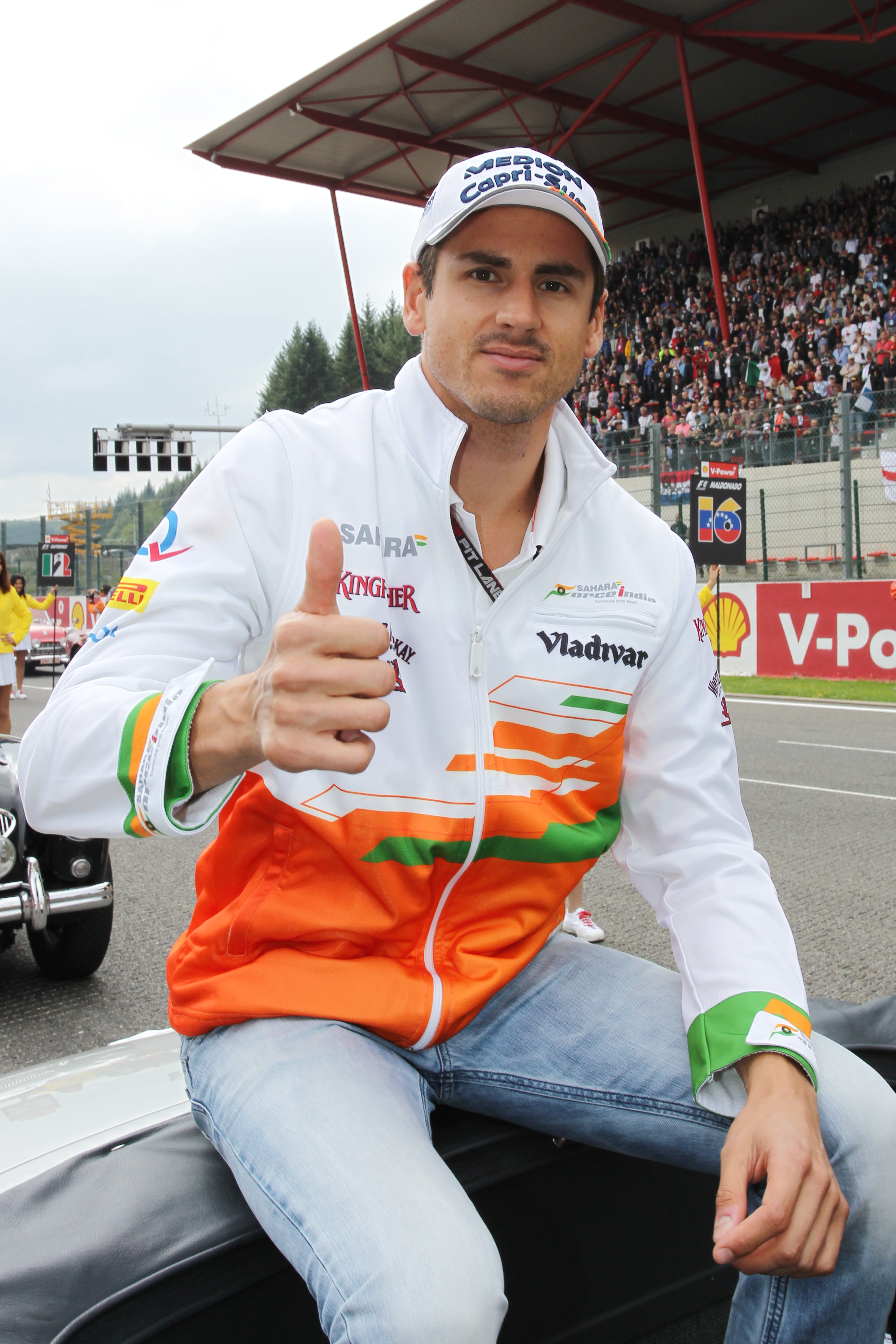
Adrian Sutil on the drivers' parade.

Adrian Sutil on the drivers’ parade.

“After the second pit stop I was racing closely with Adrian and there was a train of four cars battling as we went into the final chicane. Pastor (Maldonado) went in deep and missed the apex so I tried to get the cut-back and was going around the outside of him. He then decided to try and enter the pit lane, which was impossible given his track position.
“As a result he hit me, which took the rear corner off my car. It’s a real shame because the speed was quite strong today and I think there was definitely a point or two up for grabs.”
There certainly was…
Last word with the boss.
Vijay: “I’m pleased to see us back in the points after a fine performance by Adrian. He clearly enjoyed himself out there today and his overtaking moves were a highlight of the race. The strategy calls from the pit wall helped him stay in the hunt for points and his race pace was good.
Paul have a thoughtful session in the cockpit.

Paul having a thoughtful session in the cockpit.

“The incident with Maldonado hitting Paul was very disappointing because Paul was simply in the wrong place at the wrong time. It certainly cost us the chance to get both cars in the points.
“Going forward we will take the positives from the weekend and look to build on this performance level in a couple of weeks’ time in Monza.”

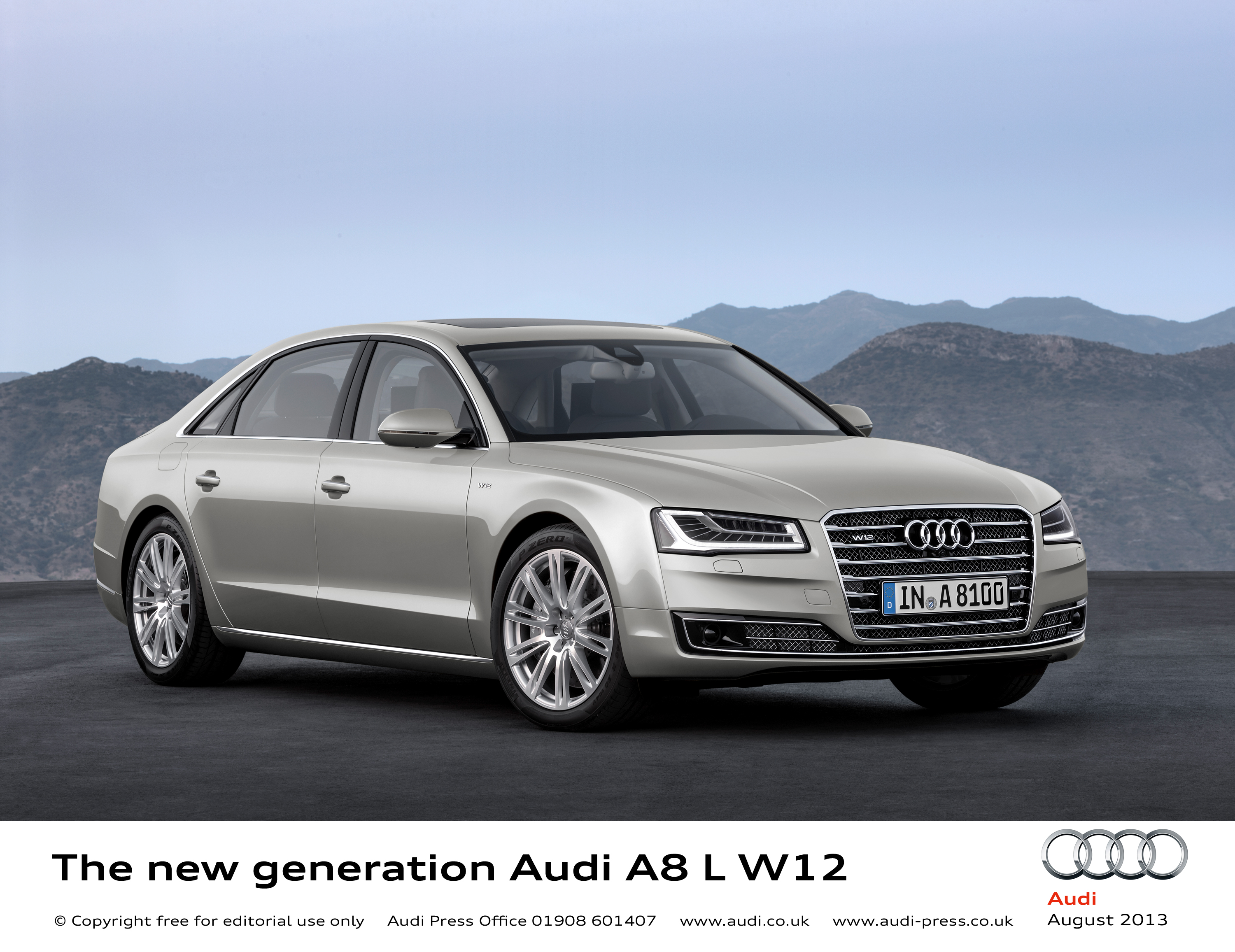
The new generation Audi A8

Unadulterated luxury is delivered with even more élan and even greater efficiency in the new generation Audi A8, which makes its debut at next month’s Frankfurt Motor Show.

The_new_generation_Audi_A8_L_W12_Audi_45974

The company’s latest flagship combines revisions to its weight-optimised, predominantly aluminium body with a raft of technological advances including new MatrixBeam LED headlights and an upgraded line-up of EU6-compliant engines.

Built around the lightweight aluminium Audi Space Frame, the almost entirely aluminium body of the new generation A8 has been finessed by subtle resculpting of the bonnet, the single frame grille, the front bumper and the lower edge of the headlight units.

At the rear, the design of the LED tail lamps has been revised and the bumper in all models (bar the S8) now incorporates two rhomboid tail pipes. New chrome elements, new high gloss black window surrounds and five new colours also mark out the updated car.

The visual appeal, visibility and active safety of the new generation A8 can also now be enhanced by new optional headlights employing MatrixBeam LEDs. The high-beam function in these unique headlights uses 25 individual LEDs per unit that can be switched on and off or dimmed individually depending on the situation.

This enables the headlight system to react extremely precisely to other vehicles while always brightly illuminating the road. When the on-board camera detects other vehicles ahead, the Audi MatrixBeam LED headlights mask the relevant sections of the high-beam by dimming or shutting off individual diodes. Very bright illumination is preserved in the remaining zones.

The lighting system in the A8 uses predictive route data from the navigation system with MMI Touch to adjust the distribution of light in response to the current driving situation, and can recognise and act on route data, such as corners and road classifications.

Fancy a job in F1?

The Infiniti Performance Engineering Academy will see two winning candidates complete a 12-month assignment with triple World Championship-winning F1 team Infiniti Red Bull Racing, based in Milton Keynes, UK.

The two graduates will work alongside Infiniti engineers already based at the F1 team’s factory. They will also spend time at Infiniti’s nearby technical centre in Cranfield where they will improve upon their knowledge of future road car technologies.

The new programme is the latest development in the Infiniti Red Bull Racing partnership. Recruitment will open later this year. National selections across several global regions will begin in May 2014, putting applicants through a comprehensive selection process to assess their performance potential and innovative thinking.

Finalists will present their ideas to a panel of senior technical figures from Infiniti and Infiniti Red Bull Racing in July 2014 with the two winners announced at the British Grand Prix. The placements will begin in September 2014. This once-in-a-lifetime scholarship includes a salary, accommodation, and the use of a car.

Says Adrian Newey, Infiniti Red Bull Racing’s Chief Technical Officer:

“One of the key advantages of our partnership with Infiniti is our ability to utilise their resources, from materials to processes and people. As such it is really interesting for us to benefit from a worldwide selection process which brings the best new talent through our door.

“The speed of technical development in Formula One means that fresh thinking is crucial in keeping ahead of the other teams and we hope that providing an opportunity for world class graduates to work with us will provide long term performance benefits for us and for Infiniti.”

Patrick Head answers lots of silly questions

As co-founder and Technical Director of Williams F1 Patrick Head was responsible for nine World Championship-winning cars.

Patrick Head fashion shot

Patrick Head fashion shot

In the process he has worked with some of the world’s most talented drivers including Alain Prost, Nigel Mansell, Ayrton Senna, Damon Hill, Jacques Villeneuve and Keke Rosberg to name but a few. Patrick is also an intrepid traveller using all forms of transport from motorbike to sailing yacht.

Here Dom Reilly talks to Patrick about his adventures in F1.

Q What’s the one luxury you always travel with?

My Macbook Air.

Q When you used to travel to places like Melbourne and Shanghai, how did you deal with jet lag? After all it’s a long way to go for a weekend!

I tried to ignore the time change and adjust immediately to the local time.  Sometimes it worked, but not always.

Q Outside F1 venues, which is your favourite destination and why? 

I normally keep my sailing boat in Calgiari, Sardinia, where my wife’s family live.  My sailboat is my greatest relaxation.  It’s usually very warm, which helps.

Q What is your preferred mode of transport?

Motorbike, but only if it’s warm.  Helicopters I enjoy but they are a bit on the pricey side.

Q What would your top tip be for international travel?

Plan in advance and find out what is available locally before you travel.

Q What would you have been if not an F1 engineer?

Unemployable.

Q Although there are now 20 races a year, things are comparatively easy in F1 these days. I remember you telling me once about how (in 1986) you did every race, every test session and travelled to Japan several times in one year to manage relations with Honda. That must have been very tough. What sticks in your mind particularly about that year?

Patrick as we usually see him. Eye to eye...

Patrick as we usually see him. Eye to eye…

Exhaustion.

Q Who’s been the most interesting person you’ve met during your career?

Placido Domingo, a big F1 fan.

Q If you could go to one place on holiday… where would it be?

Tanganyika, I would like to see wild Africa, or as close as is still there….

Honestly Patrick. What were you thinking, associating yourself with such PR drivel.

Print isn’t dead

How does news publishing change when a newspaper sells fewer than 300,000 copies but its website attracts 31 million visitors? These shifts are forcing assumptions and practices to be rethought from first principles.

The internet is not simply allowing faster, wider distribution of material: digital technology is demanding transformative change. Journalism needs to be rethought globally and remade to meet the demands of new conditions.

George Brock’s new book Out of Print: Newspapers, Journalism and the Business of News in the Digital Age examines the past, present and future for a fragile industry battling a perfect storm of falling circulations, reduced advertising revenue, rising print costs and the impact of citizen journalists and free news aggregators.

Perhaps surprisingly to some, Brock argues that journalism can flourish in a new communications age:

·      Journalism’s history shows that reporting the news is always being disrupted. The late 20th century was unusual for being a period when news was profitable and its institutions stable. Journalism has always had to adapt, experiment, improvise and renegotiate.

·      Only some journalism is under threat, particularly regional journalism. Many printed newspapers will survive, though in the UK there is currently over-supply in all national categories (mass market, mid-market, high end).

·      Print was in trouble before the internet came along. The peak year for daily and Sunday national paper circulation in Britain was 1955. What is falling apart is the industrial structure of the news business – and the ideas which went with it. The time when big news media dominated is over for print, broadcast and, even, online.

·      What the internet does to news is reroute information, measure who consumes what and rewrite the business model. It does not abolish peoples’ need to know or the need to navigate (huge) information flows – the importance of journalistic selection, navigation, curation and comment remains.

·      Unseen by many established journalists, a new generation of editors, writers and publishers are taking journalism’s values and trying to make them work in new contexts. The future of journalism depends on the quality of their experiments and failures to reboot journalism.

·      Online communications bring the industrial phase of news media to an end, returning it – via social networks – to something which looks more like the news publishing of an earlier era.

·      Online news platforms may not yet rival the institutions of mainstream media, but a few have moved past the phase of being fragile startups. Their agility (and lower cost base) will give them an advantage over time.

·      If the journalists of tomorrow want to understand what happened and what will happen, they need to understand both what’s happening to journalism and to the business of news.

Out of Print: Newspapers, Journalism and the Business of News in the Digital Age
George Brock
Kogan Page (Paperback, £19.99, 256 pages)
Published in the UK on 3 September