Chinese GP post race: Mercedes

1202294_2515974_682_1023_SNE12521


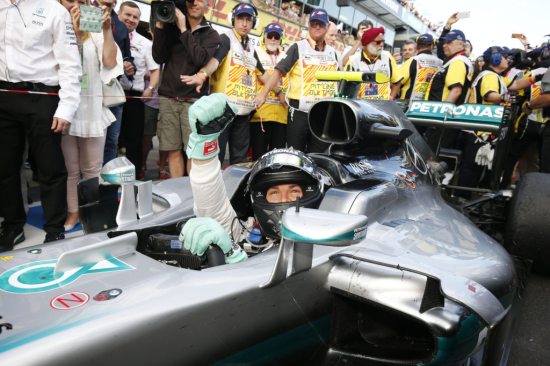
Nico Rosberg took his 17th career victory – his second at the Shanghai International Circuit, four years after sealing his first Formula One win at the same venue. Lewis Hamilton produced a battling drive to finish P7 from the back of the grid – despite incurring significant damage to his car in a first lap incident.

This result marks the 100th podium finish for the Mercedes-Benz Silver Arrows in Formula One. Rosberg (75) leads the Drivers’ Championship by 36 points from Hamilton (39) in P2. MERCEDES AMG PETRONAS (114) leads Ferrari (61) by 53 points in the Constructors’ Championship.

Nico Rosberg
“It’s been a fantastic few days for me here in China. First of all, the fans have been amazing from the moment I arrived. They’re so enthusiastic, which gives us drivers a very special feeling. Then, racing wise, it was an almost perfect weekend. Only the start could have been better – but luckily I was able to pass Daniel later on the straight and from then on I could build up a gap. I must say, I’ve never had a better balance in my car than I had today. It was really perfect, so a big thanks to everyone who helped me achieve that. I’m a very happy man today and, after three races I can be really pleased about how my season has gone so far. But it’s a very long year ahead and there’s a lot of points still on the table, so I’m not losing my focus. Now I look forward to Russia, where I started my good run of qualifying results last year. Hopefully I can get on a nice run like that again.”

Lewis Hamilton
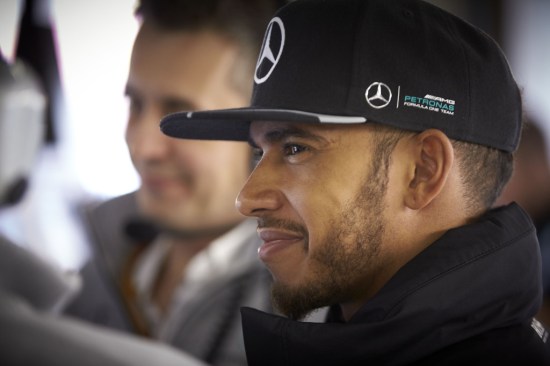
“That was definitely a difficult weekend. I got a good start – but it’s always tricky being at the back and trying not to get caught up in the domino effect of any contact at the first corner. I tried to avoid whatever happened in front of me but I just got tangled up in it. It was just a bit unfortunate, really. From there it was always going to be a battle – but I had a lot of fun fighting back through! There were plenty of overtakes, from what I can remember! I gave it everything I had and P7 was about the limit. There was nothing left in the tyres at the end and, although it’s pretty good for overtaking here, I had quite a lot of damage to the car which made it difficult to get close on the brakes. From what I could feel there was definitely some aero loss and possible suspension damage too, as the car seemed to be flexing all over the place. But that’s racing – it happens sometimes and at least I still managed to get a few points on the board. It’s a pretty big hit points-wise today – but I’ll just have to do what I can to make it up over the next few races. Onwards and upwards…”
 

1202257_2515893_1024_683_sne10552
Toto Wolff, Head of Mercedes-Benz Motorsport
“That was a rollercoaster race. Nico enjoyed the perfect weekend: he was totally dominant this afternoon, always in control of his performance and did really a flawless job. For Lewis, the circumstances couldn’t have been more different. He got a great start, tried to stay out of trouble in the first corners and still got collected by a Sauber, who was avoiding another car coming back on track. His front wing was lodged under the car for a while, which damaged the leading edge of the floor and cost him a chunk of downforce for the rest of the race – though it was hard to know exactly how much during the race. We did something different with him under the Safety Car, cycling through the SuperSoft tyre with no loss of position, in order to open up some strategic options later in the race. He put in a great recovery drive and pulled off some great overtakes – but the damage to the car meant the tyres didn’t last as long as we had hoped and made it hard to catch cars through Turn 13 before the back straight. He still did a great job and kept charging to the end – but it was damage limitation again for him this afternoon. We are just three races into the longest season in Formula One history, so this isn’t the time to be looking at Championship tables or points gaps. We just need to keep scoring points right now, continue to work on our reliability after some wobbles this weekend and keep working very hard to bring more performance to the car and Power Unit. Today looked like it could have been a three-way fight with Mercedes, Ferrari and Red Bull if our rivals had a cleaner race – so there is no margin for us to relax.”

Paddy Lowe, Executive Director (Technical)
“Starting on Lewis’ side, one of the debates we actually had overnight was whether to do a bit more work to the car and start him from the pit lane, which ironically would have been a better decision in hindsight given what happened at the first corner. Equally, Lewis had by far his best start of the season, which ironically contributed to him being caught up in the cascade of collisions ahead of him. So, a perfect storm of unfortunate circumstances all round put him on the back foot straight away. We could see that there were problems with the car – both aerodynamic and mechanical – affecting him through the low-speed corners in particular. Under the safety car, we chose to perform consecutive pit stops with Lewis to get rid of the SuperSoft and enable us to run the rest of the race on the Soft, which was the stronger race tyre. As it transpired, his first set of softs were cut from the first corner incident – something we were unaware of at the time – which meant we were then forced to run the medium at the end of the race, rendering our SuperSoft eliminating tactic redundant. So, overall, Lewis did a great job to recover what he could with a car that was significantly underperforming. On Nico’s side, he actually had a less good start, losing a place into the first corner – although he was obviously running a less grippy tyre compound than the cars around him. He was, however, able to re-pass Daniel quite quickly once DRS became available and went on to have a straightforward race from there – running a soft/soft/medium strategy as intended from the beginning. An uneventful race from his perspective – but that’s not to underestimate the top job he did to manage the car safely within its limits and claim a well-deserved third victory of the season – and the 100th Formula One podium for the Silver Arrows in the process. We now look forward to Russia – targeting a clean and successful weekend on both sides of the garage.”

Sakhir – watch out for turn 1

Just been looking through brake manufacturer Brembo’s analysis of the Bahrain circuit. All the teams now produce quite nice infographics for the GPs which I find really useful.

Definitely one of the most demanding circuits for brakes. The races on the Sakhir track, surrounded by the desert, are characterised by high temperatures that increase mechanical grip, and make it difficult to dissipate the heat generated during braking.

This aspect – combined with the presence of numerous high energy braking sections which are quite close together – makes Sakhir a hard bench test for all the braking system components which are continuously stressed by the high energy forces and the hellishly hot temperatures.

If the drivers want to finish the race, the high wear of the friction material is the biggest danger that must be avoided.

Since 2004, Bahrain has staged 10 Formula One Grands Prix. In the 2010 season the race took place on an extended layout: instead of the usual 5.412 km GP circuit, the 6.299 km configuration was used. The first man to win a race at the Bahrain International Circuit was Michael Schumacher in the 2004 season.

According to Brembo technicians who classified the 21 World Championship tracks on a scale of one to 10, the Bahrain track earned a score of nine on the difficulty index, identical to recently built tracks like Singapore and Baku, which has yet to be used.

Of the eight braking zones half are classified as difficult on the brakes, while the other four are of medium difficulty. The four most challenging braking sections – those with a deceleration greater than 4.4 g – are confronted by vehicles travelling at 300 km/h or just slightly less.

The one feared the most is the Schumacher curve (turn 1) because the drivers arrive at speed that reach 330 km/h and they have to face a 5.2 g deceleration: the braking force required is greater than 2,200 Kw, but more importantly is the brake time (1.76 seconds) which is one of the highest in the entire World Championship.

The four braking sections that have a medium level of difficulty on the brakes are all positioned in the central part of the track and are broken up only by curve 11, where a load of 143 kilos is applied to the pedal.

New F1 talent

pasted image 0 pasted image 0-1


Sedna Lighting, a British based LED lighting manufacturer and global distributor is highlighting young engineering talent in partnership with Cardiff University.

It’s supporting the local Cardiff Formula Racing Team and creating new opportunities for the young engineers of the future. The partnership highlights the University’s school of engineering and Formula racing team.

In a collaborative test of racing light in the dark, Sedna Lighting raced the CR12 series car around the home test track at Llandow.
The car, fitted with 1,500 individual LEDs from Sedna’s flexible LED strip range, was the joint effort of designers from two universities (Cardiff University and Cardiff Metropolitan University), film makers and engineers who translated the brief idea into a realistic design and created an inspirational video featuring the project.

This time Formula 1 style driving was given an unexpected twist with driving taking place in the night and cars generating exterior lighting on their own.

You can see what they got up to here.

Hermann Tilke on Baku City

Hermann_Tilke-H-cc-Thilo Vogel


The F1 circuit architect (above) has been responsible for designing the majority of Formula 1’s ‘new’ circuits, including the likes of the Yas Marina Circuit (Abu Dhabi), Marina Bay Street Circuit (Singapore), Bahrain International Circuit and Circuit of The Americas (Austin).

Most recently, he’s tackled downtown Baku circuit (Azerbaijan) as the city prepares for racing this summer.

What was your first thought when you heard of the opportunity to build a street circuit in Baku? I had no idea about the city. After my first visit to Baku I was left with just one thought: Amazing! From the very first moment, I was really proud to be a part of the project and the team here. Baku will be the world’s fastest city circuit and the track loop around the city’s historical centre will create a unique and remarkable atmosphere for fans watching in the grandstands and at home. The City Circuit of Baku is located in a vibrant city. The streets are really narrow and this is exactly what makes it so appealing.

What was the most challenging part of the construction process? Coming up with an idea for the routing of a city track suitable for F1. City circuits are always challenging to build because the team has to construct the racetrack within the city. Various problems arise when designing a circuit in the city.

What is the average lap time expected to be? We calculated a lap time of 101 seconds, but that depends on the individual set-up of the racing cars and on the developments of this year’s new cars. The brake point in front of Turn 8 is V max= 204km/h. Between T8 and T9 we expect a V min of 86 km/h. The layout of the track is designed to show off the beauty of the historic and modern views and sights of Baku.

You can also race the virtual circuit.


F1 at Donington


240316-donnington-a 240316-donnington-b


The unmistakable sound of Formula 1 engines will echo round Donington Park on Saturday 30 April and Sunday 1 May as historic cars stage a series of demonstrations on the first two days of the Donington Historic Festival.

The youngest of the demos will be the 2002 Jordan EJ12 from Takuma Sato’s F1 debut year, the Michael Schumacher 1992 Benetton B192, and the 1990 Camel Lotus 102 (Derek Warwick/Martin Brundle/Johnny Herbert).

The previous two decades will be represented by the Rupert Keegan 1977 Hesketh 308E, 1983 Williams FW08 (Keke Rosberg/Jacques Laffite), the Jean-Pierre Jarier/Piercarlo Ghinzani/Corrado Fabi 1983 Osella FA1-D and two Tolemans. The 1985 TG-185 is Teo Fabi, while the 1984 TG-184 was Ayrton Senna’s regular test car throughout 1984, and is the car in which he caused a sensation in Friday practice for the British GP at Brands Hatch, setting the fastest time in both of the day’s sessions.

Q&A with Haas F1

Guenther Steiner, Team Principal

Haas F1 now has its first grand prix under its belt. Obviously this was highlighted by Grosjean’s sixth-place result, but how did it go overall and what can you take from Australia and apply to Bahrain?
“We had our ups and downs. It started out with not being able to get enough testing in on Friday during practice. We tried to make up for it on Saturday morning during third practice, but we had an incident with a car colliding with Romain (Grosjean) as he was exiting the garage.

“It started off not too pretty, and then qualifying was not what we wished for, but the team bounced back and we got ready for Sunday. We showed a good race speed and we are ready to go racing. In the end it was all positive. It was hard to get to the positive, but with a lot of work with a lot of hard-working people, we got there. Now the biggest task is to replicate this, which won’t be easy, but for sure we will be trying again.”

Upon your return to Haas F1’s headquarters in North Carolina were you able to get a sense of how the team’s Australia performance resonated in the US?
“I think it resonated in a very positive way in all of racing in America. Even those who don’t follow Formula One considered it a big achievement for a new team to finish in sixth place and to be from America, which hasn’t had a presence in Formula One in 30 years.”

From the outside looking in, it appeared the team was taking a very unorthodox approach to building a Formula One team. And while that is relatively true, did the team’s performance in Australia vindicate your methodology, specifically in regard to partnering with Scuderia Ferrari and Dallara?
“I think our plan is working, but we won’t finish sixth every weekend, so we need to be careful with our expectations. I think we showed that you can start a new team and end up in the midfield. We were not last in Australia, which was one of our goals, and I don’t think we will be last this year. How far we’ve come is a sign that our plan is working.”

Haas F1 came out of the gate strong in the season-opener in Australia. History tells us not every grand prix will bring that kind of success. How do you manage expectations, internally and externally?
“We are not being arrogant about our early success and we will have our races where we will underperform. Our sixth-place finish in Australia keeps the team going, working very hard and trying to do the best possible job we can. If we continue to do what we did in Melbourne, good results will come.”

The flip side to Grosjean’s sixth-place finish at Australia was Gutiérrez getting caught up in a crash. There was a good bit of damage to the left-rear of Gutiérrez’s car. What needs to be done to repair it and what kind of logistics are involved to get it ready for Bahrain?
“Some of the parts, for example the chassis, were sent back to Europe to be checked and fixed because we can’t do it onsite in Bahrain. We have enough spare parts to build up another chassis, so we will use that. Then the chassis that is repaired will be sent to Bahrain via air to serve as our spare. The guys will have to work day and night to get to Bahrain, but it’s all doable. Our spare quantity is down, but we have enough to get going again, so we will just keep on working.”

You appear to have handled adversity extremely well – be it with technical issues during the second week of testing at Barcelona and when you endured a pit lane collision in practice Saturday at Australia. From your perspective, how well is this new group of personnel working together?
“We chose good, quality people. Nobody gets down in adversity. Everybody gets up. They are working on the solution, not on the problem. They work together because they are professionals and they know they can get it done together as a team. It all comes down to the quality of people, and I think our quality is pretty high.”

With wet weather Friday at Australia, it compromised the team’s ability to work on the car’s set-up for the race. The weather in Bahrain is usually pretty consistent, and that means consistently dry. How helpful will a full weekend of consistent weather be for you and the team?
“If we can get a good day of practice in with both cars and six hours of running, that will be fantastic just to learn more about this machine.”

With Gutiérrez’s lap 17 crash and Grosjean changing tyres during the red flag, you didn’t make any pit stops in Australia. How is the team preparing for pit stops and is there any worry this is one element of the programme that hasn’t really been tested?
“We didn’t complain that we didn’t have to do a pit stop in Australia, but we will have to do it in Bahrain, for sure. We will do a lot of things during practice in Bahrain to ensure that we are ready. We got away with not doing pit stops in Australia, but we won’t be able to in Bahrain. The focus will be on completing pit stops this weekend so the team goes into the race confident that they have trained properly.”

How did the addition of a third tyre option impact your strategy for Australia, and what impact do you think it will have on your tyre strategy for Bahrain?
“Everyone has the third tyre option, so you just deal with it. I don’t think it has a huge impact because it’s the same for everybody. We just need to make sure we use the three options we’ve got to the best of our knowledge.”

Whilst we’re at it… the tyres

Pirelli is bringing three tyre compounds to Bahrain:

P Zero White medium – less grip, less wear (used for long-race stints)
P Zero Yellow soft – more grip, medium wear (used for shorter-race stints and for the initial portion of qualifying)
P Zero Red supersoft – highest amount of grip, highest amount of wear (used for qualifying and select race situations).

Two of the three available compounds must be used during the race. Teams are able to decide when they want to run which compound, adding an element of strategy to the race. (If the race takes place in the wet, the Cinturato Blue full wet tyre and the Cinturato green intermediate tyre will be made available.)

A driver can use all three sets of Pirelli tyres in a race. For example, if they used the P Zero Red supersoft to advance from Q2 to Q3, they would start the race on those tyres and attempt to make some lightning-quick laps to gain a margin over their counterparts before pitting for the P Zero White medium. Then depending on circumstances that unfold during the race, another pit stop could be made for the P Zero Yellow soft, allowing the driver to better attack during the race’s closing laps.

Pirelli provides each driver with 13 sets of dry tyres for the race weekend. Of these 13 sets, drivers and their teams can choose the specifications of 10 of those sets from the three compounds Pirelli selected. The remaining three sets are defined by Pirelli – two mandatory tyre specifications for the race (one set of P Zero Yellow softs and one set of P Zero White mediums), and one mandatory specification for Q3 (one set of P Zero Red supersofts).

Qualifying again…

After much deliberation, the new qualifying procedure Formula One debuted in the season-opening Australian Grand Prix is back at Bahrain. In case you were wondering, it’s an elimination-style format broken into three sessions and it works like this:

Q1
Lasts 16 minutes, with all 22 drivers participating
After seven minutes, the slowest driver is eliminated
In 90-second intervals thereafter, the next slowest drivers are eliminated until the checkered flag falls
Seven drivers get eliminated, with 15 drivers moving on to Q2

Q2
Lasts 15 minutes, featuring the 15 fastest drivers from Q1
After six minutes, the slowest driver is eliminated
In 90-second intervals thereafter, the next slowest drivers are eliminated until the checkered flag falls
Seven drivers get eliminated, with eight drivers advancing to Q3

Still with me?

Q3
Lasts 14 minutes, featuring the eight fastest drivers from Q2
After five minutes, the slowest driver is eliminated
In 90-second intervals thereafter, the next slowest drivers are eliminated until the checkered flag falls
Two drivers will remain in the final 90 seconds, theoretically creating a shootout for the pole.

Any questions? Yes, it will be a disaster… again.

Qualifying

They’re going ahead with the same approach for the Bahrain Grand Prix, and review it after the face.

Why? First Bernie says F1’s boring and wouldn’t take his famille along to watch, then we have this farce in qualifying. I’m beginning to think there’s a sub plot at work to which we’re not privy.

Well, what did you think of Channel 4’s F1 coverage?

Adverts. I just hate the adverts.

We’d been promised uninterrupted coverage but this seemed to be a play on words. We went back to where we’d left off after what seemed like an interminable break – usual in so many ways these days – and viewers hadn’t ‘missed’ anything, but in a way they did.

The live element – even if perceived to be live in a recording – is important for F1. It’s one of those sports that demands continuous coverage or we just lose the element of excitement.

Certainly the balance of David Coulthard and Mark Webber – who stole the show in my view – really worked. Steve Jones was filled with enthusiasm and was somewhat in awe to find himself in such illustrious F1 company it seemed.

But I’m sorry to say by the second round of ads I turned off to follow the ‘action’ via other feeds. This means I missed the rest of the team who I’m sure were marvellous.

Australian GP – Williams images

And some nice ones as well…


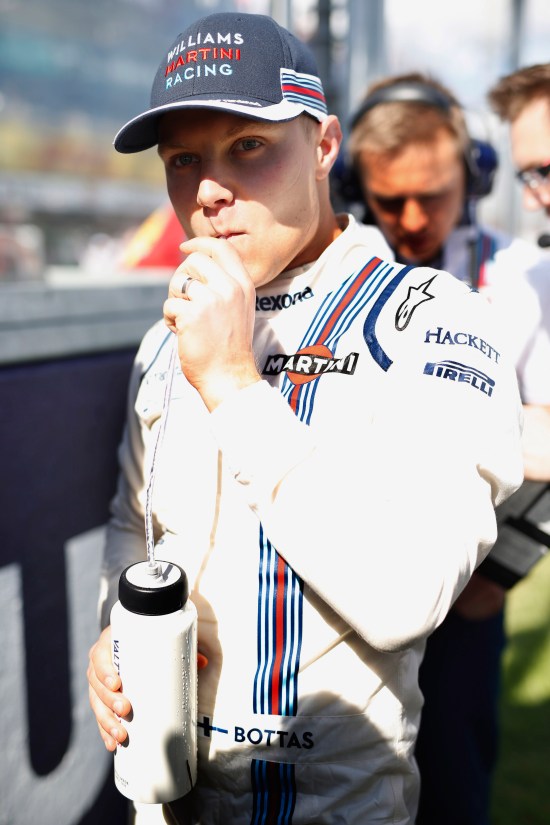
Albert Park, Melbourne, Australia. Sunday 20 March 2016. Valtteri Bottas, Williams Martini Racing. Photo: Glenn Dunbar/Williams F1 ref: Digital Image _89P5035

Valtteri Bottas

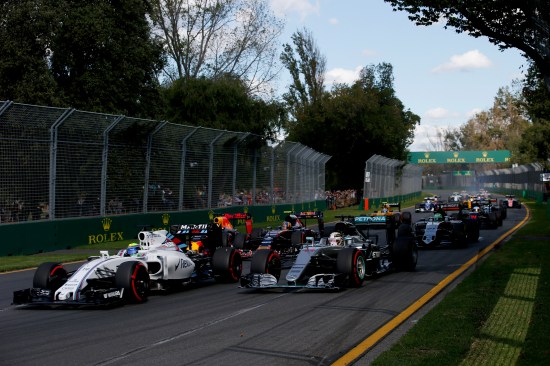
Albert Park, Melbourne, Australia. Sunday 20 March 2016. Felipe Massa, Williams FW38 Mercedes, leads Lewis Hamilton, Mercedes F1 W07 Hybrid, Daniel Ricciardo, Red Bull Racing RB12 TAG Heuer, Carlos Sainz Jr, Toro Rosso STR11 Ferrari, and the remainder of the field on the opening lap. Photo: Sam BloxhamWilliams F1 ref: Digital Image _L4R5038

Felipe Massa leads Lewis Hamilton, Daniel Ricciardo, Carlos Sainz Jr and the remainder of the field on the opening lap.

Albert Park, Melbourne, Australia. Sunday 20 March 2016. Felipe Massa, Williams Martini Racing, has his photo taken with fans. Photo: Glenn Dunbar/Williams F1 ref: Digital Image _W2Q3072

Felipe Massa having his photo taken with fans.

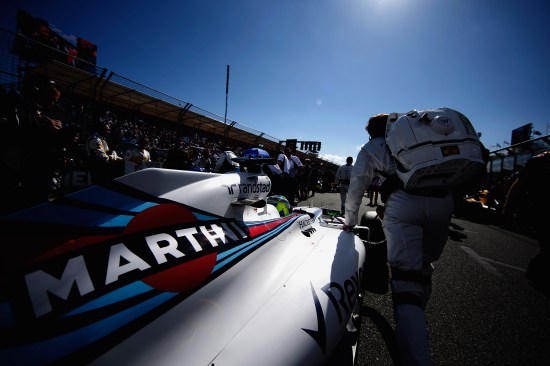
Albert Park, Melbourne, Australia. Sunday 20 March 2016. Felipe Massa, Williams FW38 Mercedes, arrives on the grid. Photo: Glenn Dunbar/Williams F1 ref: Digital Image _W2Q3776

Felipe Massa arrives on the grid.

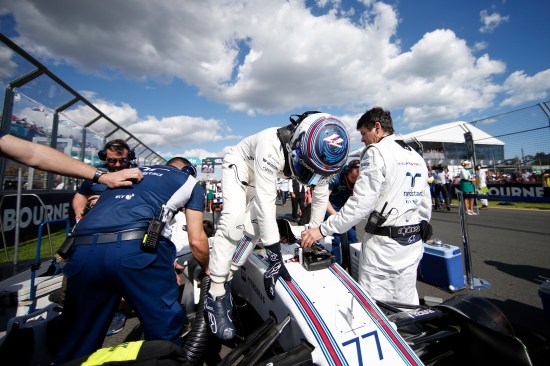
Albert Park, Melbourne, Australia. Sunday 20 March 2016. Valtteri Bottas, Williams Martini Racing, on the grid. Photo: Glenn Dunbar/Williams F1 ref: Digital Image _W2Q3810

Valtteri Bottas on the grid.

Albert Park, Melbourne, Australia. Sunday 20 March 2016. Valtteri Bottas, Williams FW38 Mercedes, makes a pit stop during the race. Photo: Steven Tee/Williams F1 ref: Digital Image _X0W6601

Valtteri Bottas makes a pit stop during the race.

Australian GP post race – Force India

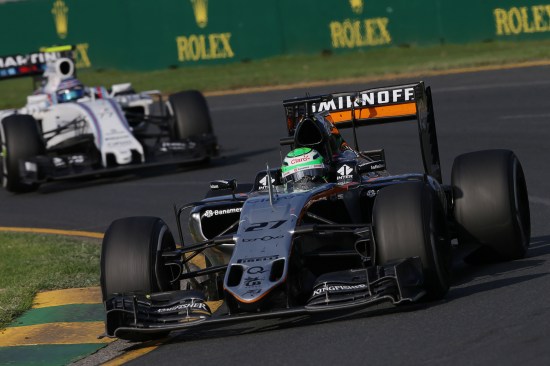
Nico Hulkenberg in the VJM09.

Nico Hulkenberg in the VJM09.


Force India scored six points in today’s season-opening Australian Grand Prix with Nico Hulkenberg coming home in seventh place ahead of Sergio Perez in P13.

P7 Nico Hulkenberg VJM09-01
Strategy: New Softs (16 laps) – New Mediums (41 laps)
“To get some points in the bag at the first race is a positive way to start the year. It was not an easy day and it’s difficult to know what would have happened without the race being stopped and restarted. I think the red flag made things a lot more difficult for our planned one-stop strategy because it gave everybody around us the chance to reset and change their tyres.

“So that was a shame and it meant I was out of position and got stuck behind the Haas for most of the race. It was not easy to get close to Romain and I had a lot of cars behind me, which meant I was always under pressure and having to defend as well as chase. So, given all the circumstances, seventh place feels quite satisfying.”

P13 Sergio Perez VJM09-02
Strategy: New Softs (16 laps) – New Mediums (41 laps)
“It’s a real shame to finish outside of the points. My problems began at the start: I lost a couple of places off the line and that put me in a very difficult position. I spent my first stint behind Alonso, who was on a faster compound, and being stuck in the dirty air destroyed my tyres. Unfortunately there was a very similar situation after the restart because I was passed by Jenson (Button) who was on supersoft tyres and that cost me a lot of time.

“Sadly the Safety Car and the red flag ruined our strategy which was to stop only once. When the race restarted we had our work cut out: I had pressure from behind and the Renaults and Williams ahead were very difficult to catch – I got close but couldn’t really attack. In the end I had an issue with overheating brakes, probably because I spent most of the race in traffic, but we still managed to finish the race.

“It’s not an ideal start of the season for me, especially after the good work we had done in qualifying yesterday, but we have to keep looking ahead and continue working hard.”

Robert Fernley, Deputy Team Principal
“The first race is always a bit of a step into the unknown, so getting some points on the board is a positive conclusion to a challenging weekend. Our strategy was shaping up very nicely with the plan to stop both cars only once, but the red flag reset the strategies of everyone around us and made our task much more difficult.

“Making our pit stops just prior to the safety car also cost us track position. Getting Nico back up to seventh place was a good recovery and he did an excellent job of containing Bottas and the Toro Rosso pair for most of the afternoon. Sergio’s strategy was also undone by the red flag, even more so than Nico’s because he dropped to the back of the midfield traffic jam and suffered with high tyre degradation. So a day of mixed fortunes for us, but at least we’ve got some points on the board and we are looking forward to Bahrain.”


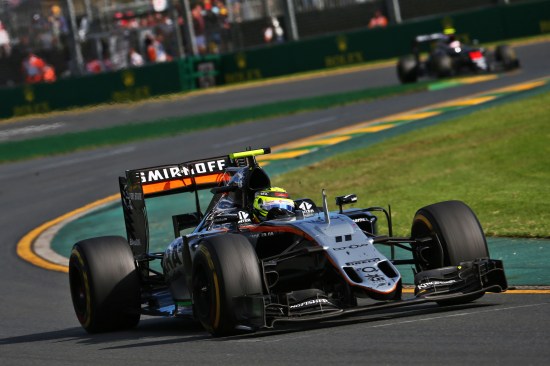
Sergio Perez

Sergio Perez

Australian GP post race: Haas F1

Wet nose


Haas F1 made history before and after the 32nd Australian Grand Prix Sunday in Melbourne. The organisation’s debut in Round 1 of the 2016 FIA Formula One World Championship marked the first time a US team had competed in Formula One since 1986. And after ending a 30-year drought for an American squad in Formula One, Haas F1 ended another drought for an organisation’s maiden F1 race.

After starting 19th, Romain Grosjean finished an impressive sixth, earning the team eight points in the constructor standings. The last time a Formula One team scored points in its debut race was in the 2002 Australian Grand Prix when Mika Salo finished sixth for Toyota.

The fortunate outcome was due in part by the misfortune of Grosjean’s teammate, Esteban Gutiérrez who was taken out of the race in a spectacular accident involving McLaren driver, Fernando Alonso. On lap 17 while entering turn three of the 5.303-kilometre (3.295-mile), 16-turn circuit, Alonso moved to the outside of Gutiérrez in an attempt to overtake.

Alonso’s right-front wheel touched Gutiérrez’s left-rear wheel. The impact launched Alonso into the air and sent Gutiérrez spinning into the gravel trap. Alonso clipped the outside retaining wall and then sailed over the gravel trap. His splintered car ended up on its side against another wall, whereupon Alonso climbed out. Gutiérrez quickly came to check on his fellow driver, and the two walked away unscathed from the harrowing accident.

With debris littering the track, officials displayed the red flag. The field came to the pit lane where the cars were stopped, and the only work teams could do to their cars was change tyres.

After starting the race on the Pirelli P Zero Yellow softs, the team took advantage of the red flag and changed Grosjean’s tyres to the Pirelli P Zero White mediums. While the mediums did not have nearly as much grip as the softs, they also did not wear out as fast. When the race went back to green, Grosjean was good to go the distance without pitting.

His strategy was to outlast and outrun as many of his counterparts as possible. He succeeded, with only five drivers finishing ahead of him, all of whom belonged to race teams with decades of experience. The sixth-place finish was worth eight points, placing Haas F1 Team fifth in the constructor standings.

F1 is back, and America is back in F1 in a big way.

Australian GP post race: Mercedes

1198445_2505716_1024_683_ROS_02 1198455_2505746_1024_683_sne22084


Nico Rosberg and Lewis Hamilton have clinched a memorable 1-2 after a thrilling race in Melbourne. This was the former’s 15th career victory – his second at the Melbourne Grand Prix Cicuit. Hamilton claimed his 88th Formula One podium.

After a poor start dropped them from the front row to P3 (Rosberg) and P7 (Hamilton), strong drives and good strategy calls saw both recover to cling on from a hard-charging Vettel. Rosberg now leads the Drivers’ Championship by 7 points from Hamilton (18) in P2. MERCEDES AMG PETRONAS (43) leads Ferrari (15) by 28 points in the Constructors’ Championship.

Nico Rosberg
“That was a perfect race for me. The start was tricky, as I was on the dirty side of the grid and Vettel managed to be ahead. He did a really good job at the start – but we chose the perfect strategy by going on to the medium tyre after the red flag. We know now just how strong those red cars will be this season, so we cannot afford to relax. Finally, I also have to say it was a big relief to see Fernando walk away from his shunt. It shows how incredible the safety of these cars is now, which is great to see.”

Lewis Hamilton
“I’d had a perfect weekend in every way up until the lights went out and felt confident heading into the race. I got a bit of wheelspin off the line then got pushed wide at the first corner, so from there it was just about recovering. But these things happen and I’m grateful for the way I was able to fight back through.

“P2 isn’t bad in terms of damage limitation after a start like that. I spent a long time stuck behind one of the Toro Rossos and there wasn’t a lot I could do about it as he was on a quicker tyre. I could just see the others pulling away, so the safety car definitely helped by bunching us all up again.

“I was already on a one-stop strategy and, to be honest, I don’t know why everyone else didn’t do the same on the medium. I’m happy they didn’t, as I probably would have finished a lot further back. In any case, the team did a great job to help us pull it back and there’s still 20 races to go, so I’m feeling pretty chilled. I’ve had far worse starts to the season, so I’ll take that today and head into the next one looking up.”

Toto Wolff, Head of Mercedes-Benz Motorsport
“First of all, a big relief to see Fernando walk away from that shunt. The race itself was extremely tense throughout – a real cliffhanger and a great way to show what Formula One is really about. We didn’t get it right at the start. The drivers were slow away from the line then touched at the first corner, so we were forced into recovery mode. Our plan from there had been to put Nico on a two stop and Lewis a one stop strategy before the red flag came out. We did the maths and opted to go with one set of mediums to the end, with the drivers on the knife edge of endurance and performance.

“Managing tyres and temperatures became a big challenge, with debris causing an overheating brake caliper that almost forced us to retire Nico at one stage. Thankfully that was not the case and he led Lewis home for a hard-fought 1-2. A perfect result to start the year, a great job from the drivers to manage and recover the race, fantastic work on the pit wall to give them the right strategy to do so and an incredible team effort from everybody at the factories to get us here. We must now sort our starts and look to carry out momentum into Bahrain.”

Paddy Lowe, Executive Director (Technical)
“What can you say after a race like that? Absolutely fantastic to get a 1-2 at the first race of the season – particularly after we made life very difficult for ourselves with a pair of poor starts. After the red flag we opted to run the medium tyre to the end and expected others to do the same – which would have made the win a very big ask, let alone a 1-2.

“Of course, we can look back and enjoy it now – but it was quite stressful at the time. It made for a great spectacle, so I hope the fans enjoyed it. Overall, we can be extremely happy today. Congratulations to everyone back at Brackley, Brixworth and Stuttgart. Together, they’ve produced a car which has given us the perfect start to the season in very exciting circumstances.”

Australian GP: qualifying

Probably the best approach to Formula One’s latest elimination-style qualifying format is to ignore it. Hamilton’s in pole. That’s all you need to know.

Let’s see how the race goes tomorrow and whether Bernie comes to his senses.