Frank’s FW36

_L5R8262-lr


Following on from its successful 2014 season, Williams’ Chief Technical Officer, Pat Symonds takes up the story behind the development of this year’s car:

“We went about recognising what had worked well with the FW36 and identifying and resolving the areas that we felt needed to be improved. Although the aerodynamics of the car were impressive there is always room for improvement particularly as we handle the new 2015 nose regulations.

“The first conceptual stage of the FW37 came before the FW36 had turned a wheel. The main element to this is understanding the rule changes and how they will affect the design of the car. From here we can start to see if our ideas will fit within the regulations.

‘The desire to beat Ferrari to third place in the Constructors’ in 2014 meant we pushed our development through to late autumn, but the size of the team is now at a point where it was able to sustain this development whilst still working on the FW37.”

With the regulations relatively stable from 2014 the team went about developing the FW36 with the additional changes necessary to meet the 2015 rules. Adds Symonds:

“We felt we came up against design barriers in the FW36 and so took the opportunity to remove these for the benefit of performance. The FW36 carried a reasonable amount of ballast, so we were able to make alterations to the design for added performance without the fear of adding excessive mass.”

The layout phase of the car was completed by the summer break in August, with work on the new front bulkhead a main priority for the designers and aerodynamicists as the changes to the regulations had their effects on the car.

Says Symonds:

‘The change in regulations offered us a slight headache. The new front bulkhead and nose geometry had much more of an impact than we had initially anticipated and the effect on the aero was profound. The team has worked hard on pulling back the deficit these regulations have made for us.

“‘The more rule stability there is, the closer the field gets. I hope as a team we are more capable of maintaining the forward momentum to catch Mercedes, than the teams behind us are of catching us. It’s not just about stable regulations but also about the team and every individual that works here moving forward and improving.”
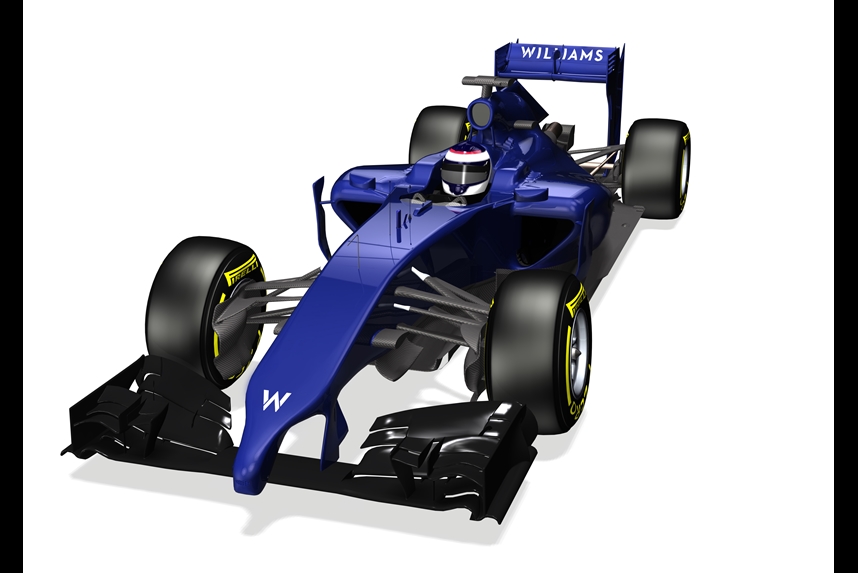
The new Williams

WF1_FW36_ISO-gallerywide

WF1_FW36_SIDE-gallerywide


Williams has released the first images of its 2014 challenger: the Williams Mercedes FW36.

It’s the culmination of two-plus years research and development by the team’s technical departments in Grove and it incorporates the power unit from the team’s new partner, Mercedes-Benz.

Says Chief Technical Officer, Pat Symonds:

“There’s a lot more technology on the cars this year. We’ve had turbo-charged engines in F1 before; what’s different this time is that it is much more than just an engine change, it is a completely different system.

“We’ve gone from a slightly hybridised, normally aspirated engine to a fully integrated hybrid power unit with novel technology at its heart.”

To meet the challenges of the new power unit, Williams signed the deal with Mercedes-Benz High Performance Powertrains midway through last season. The team received the first CAD (computer-aided design) data for the power unit at the end of May, at which point the detailed design of the FW36 could begin to be finalised.

This is the first time that Williams has worked with Mercedes in F1.

The design phase of the FW36 was completed by mid-September, by which time the team had found solutions to the major challenges presented by the regulations. (Cooling, weight, a new gearbox and aerodynamic changes are just some of the areas of focus.)

Continues Symonds:

“Overall the cars will need more cooling this year. The demands on water and oil cooling may be slightly diminished, but the ERS system is significantly more powerful and hence needs more cooling. We also have to cool the charge air from the turbocharger compressor which requires a substantial intercooler.”

The FW36’s gearbox ran on the dyno for the first time at the beginning of November, before running with the full power unit several weeks later. It’s the first eight-speed gearbox in Williams’ history.

Says Symonds:

“We finished the gearbox relatively early. It’s completed a lot of running on the test rig and at Mercedes HPP in Brixworth, but you can’t take reliability for granted. It’s a completely new box and it has to cope with a lot more torque than was the case with the V8.”

The weight of the car, when combined with the FIA’s ever more stringent crash tests, has been another challenge of the 2014 rules. But the FW36 was one of the first cars to pass its crash tests prior to Christmas.

“The build of the new car has gone remarkably smoothly,” says Symonds. “But it’s been a challenge to get the car down to the weight limit. It’s been achievable, but it hasn’t been easy because the new power unit is heavier than the outgoing V8.”

The launch-spec aerodynamic package was finalised in the first week of December, with an upgrade package for Melbourne’s season-opener signed off in early January.

Adds Symonds:

“F1 is still going to be an aerodynamic formula in 2014. There are some significant changes: the nose is lower than last year and the front wing is narrower, which means the end plates are now more shrouded by the front tyre.

“The rear wing isn’t as deep as last year and the beam wing below it is no longer permitted, and we’ve also lost the ability to use the exhaust to enhance aero performance.”

Until the car begins testing the team won’t know how its design solutions will translate on to the track, but Symonds is confident that Williams has done enough to move up the grid after a disappointing 2013 season.

“I’m confident that we’ll be closer to the front aerodynamically than we were last year,” he says. “Our ambition for the year ahead is to have a strong 2014 season.”